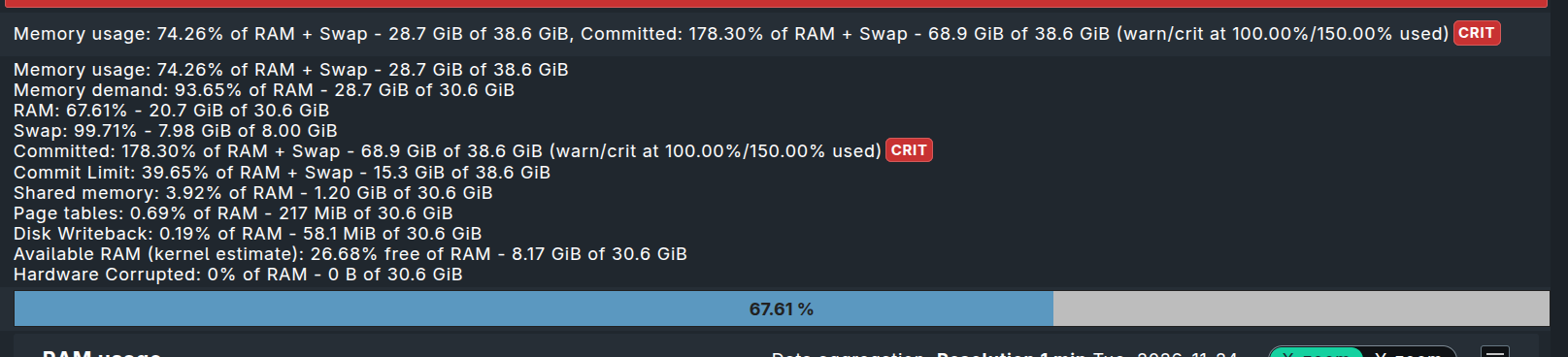
We are reviewing the mem_used check and noticed something that we would like to understand better.
For the “Total (RAM + Swap)” value, Checkmk appears to calculate:
(RAM used + Swap used) / RAM total
rather than:
(RAM used + Swap used) / (RAM total + Swap total)
For example, with 6.12 GiB RAM used, 756 MiB Swap used, 7.63 GiB total RAM and 3.91 GiB total Swap, Checkmk reports 89.92%, while using RAM + Swap as the total available memory would give approximately 59.4%.
We understand that this may be intentional rather than a bug, but the calculation seems unusual to us considering that the value is labelled “Total (RAM + Swap)”.
Could you explain the reason behind using only total RAM as the denominator?
The advantage of the chosen metric (RAM used + Swap used) / RAM total is that it allows to define meaningful thresholds that work on a broader range of systems, like WARN at 125% (system is lightly overbooked) and CRIT at 175% (severely overbooked).
With the metric (RAM used + Swap used) / (RAM total + Swap total), you can not tell if a measurement of e.g. 65% is actually harmful for the performance of the system, because it depends of the ratio of available RAM and Swap.
I thought a bit about it and currently we don’t do a great job to make this very clear. Even worse, in Linux we don’t show this memory demand anymore (RAM + SWAP / RAM).
I am considering the following change (for Linux):
Total virtual memory: 76.69% - 29.6 GiB of 38.6 GiB
→ Memory usage: 76.69% of RAM + Swap - 29.6 GiB of 38.6 GiB
Does not exist…
→ Memory demand: 96.72% of RAM - 29.6 GiB of 30.6 GiB
Besides the renaming of Total virtual memory, I also moved the “of what” from the absolute numbers to the % area so that you know immediately on which base the calculation is done